
We owe much of our sense of what the late eighteenth century sounded like to a peripatetic organist from Shrewsbury. Charles Burney, who in the early 1770s travelled through France, Italy, Germany and the Netherlands, a composer more jobbing than great and too often unfairly consigned to a footnote. But he listened, he asked questions of the European music scene, and he wrote it all down: the instruments in the room, the manner of the players, the temper of the patron. His tours, and later his General History of Music, made the Continental musical world legible to English readers. When Haydn arrived in London in 1791, it was Burney who helped smooth his path, and it is largely through Burney's ear that we know how a Haydn keyboard sounded in an English drawing room.
Thanks to the Shropshire Music Trust, until October 31st, you can enjoy a special tercentenary exhibition at Shrewsbury Library celebrating the birth of this overlooked legislator of 18th century taste, including a first edition of his history.
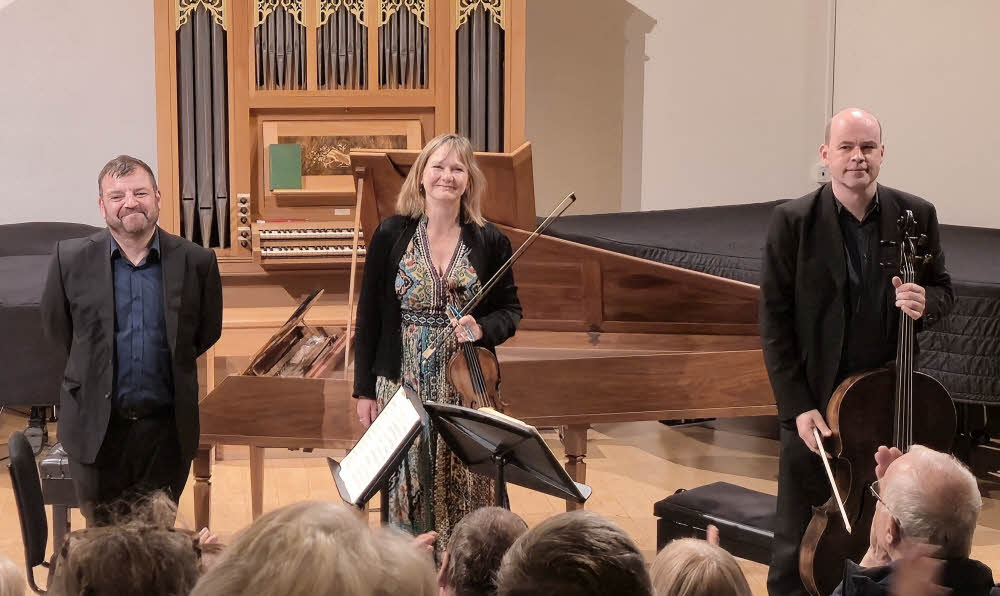
On Friday, we got the Burney experience first-hand. In the 21st century surroundings of the Maidment Building, The Devine Musick Piano Trio delivered repertoire from the 18th as though Burney were in the audience quilling down notes. The combination of a fortepiano, a gut-strung violin and a gut-strung cello are not a modern piano trio in period costume. It is a different creature entirely, as their programme proved, showcasing delightfully re-engineered balance, and re-imagined textures that presented the zing, the real-deal artistry of period pep.
Haydn's E major trio, one of the late London set, began. On a modern Steinway it can sound like a piano concerto with obbligato strings. But here the balance was rendered more honest. The fortepiano's bright, quick-decaying tone cannot smother anyone, so the violin and cello could speak at their natural weight. Haydn’s sudden harmonic swerves registered as jazzy wit, sparks in conversation over which no one instrument lorded. Pianist Steven Devine let the instrument's articulate, almost speech-like attack do the work of phrasing. We heard anew the finale which had a lightness that a heavier sonority would have flattened.
Mozart's G major (K. 496) followed, and it was here that reconsideration of the fortepiano as a more innocently mischievous string instrument blent wonderfully with the grainier, singing tone of Caroline Balding’s violin and Andrew Skidmore’s cello, so often condemned to shadow the keyboard bass, particularly in the Andante middle. The filigree gleamed in the exchange between these three separate voices where registers made possible freshly heard and distinct personality, as the tone turned darker in the final Allegretto. The delicate range of texture offered myriad variations on cool, tingling temperature, like the presentiment you might feel wild swimming in late autumn.
The trio closed with Beethoven's Op. 1 No. 1. This is the young Beethoven announcing himself in Lichnowsky’s salon, with Haydn, the story goes, listening politely and offering doubts about the third trio of the set. But there was no doubt about this first one. Here was all the drama of operatic hubbub distilled from that contemporary Viennese air. Where Beethoven’s new demands for power pushed the available technology to its limit, we really felt the tension and productive strain of a style in transition. The sforzandi bit deeper, the dynamic extremes roller-coastered into fresh and visceral encounter. The slow movement had a rapt, intimate quality that a modern hall often dilutes. It’s what Burney sensed at the time: this repertoire was written for rooms, for listeners close enough to catch the detail. Rarely has this kind of imaginative intervention on the Classical status quo been so welcome, or so Devine.
James Fraser-Andrews


