
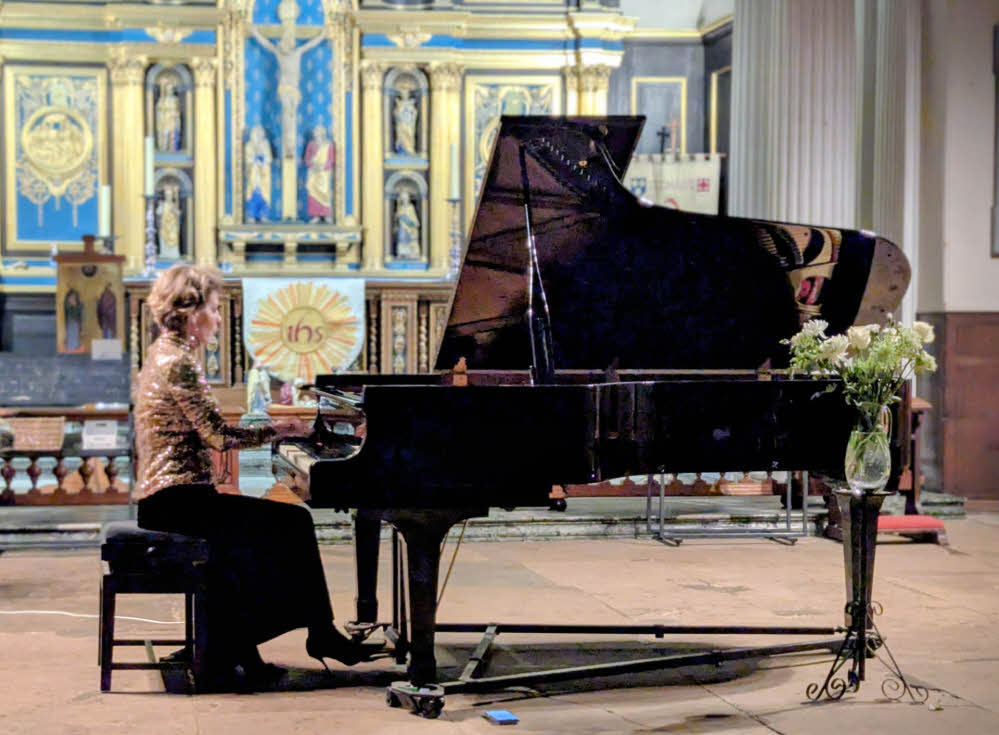
Rare are the occasions that an artist meets their art in the crucible of audience so completely that the performance transcends the here-and-now and so inhabits a world of ideas unassailably unique – impossible otherwise to imagine, fundamentally indescribable (I’ll try), and, although we would dearly wish the contrary, never to be repeated.
But such was created by Polina Osetinskaya. The Russian pianist powerfully demonstrated why she is hailed as one of the most exciting on the international circuit and here she was, a vision of sparkling poise, and weaving an unbreakable spell for two hours over the packed St Chad’s audience on a drizzling Friday night in Shrewsbury. Bravo, and double hats off to John Moore and The Shropshire Music Trust for enticing her to SY1.
Douglas Adams said Bach tells you what it’s like to be the universe. From the first notes of this hotly anticipated recital, we found ourselves at its stillest point. This first half set of transcriptions began with an arrangement of the Sinfonia from the Christmas Oratorio that Osetinskaya plucked tenderly from the ether, already spinning with its cosmic harmony.
Her conception was a discovery in all senses of the word: astonishing, searching, an unveiling. Specially commissioned from Asiya Korepanova, she had wanted a piece “to include all Bach’s intricacies”. Oh, and then some… intricacy and orchestral textures danced
under her fingers with impeccable control and exquisite balance. More familiar transcriptions by Kempff and Bauer followed of ‘Jesu Joy’, ‘Die seele Ruht in Jesu Handen’ (beautifully romantic, this) and ‘Sleepers Awake’, each a masterclass in melodic soul.
The Concerto for four Harpsichords, itself a transcription from Vivaldi, showcased the art of transcription in the 21st century. Osetinskaya, a recording artist with mesmeric renditions of Scarlatti to her name, embraced the change of tone to Italianate brilliance in Florian Noack’s version with articulate flourish, two delphinian wrists conjuring the work of eight hands and a baroque orchestra with virtuosic bravura, yet filling the church with such light as if her performance could shoot rays through the church’s stained glass to illuminate the gloom outside. Her Bach/Busoni ‘Chaconne’, which closed the first half, was monumental. Every part of the piano’s range came into being to voice its many tragic colours. And, mein Gott, she made it roar.
The second half served up a feast of Rachmaninov preludes. The famous C-sharp minor opened as you might expect but with a quite unanticipated and refreshing sylphen grace.
This sense of play permeated her selection from the two sets, Op.23 and Op.32, even amid the thickets of chords in the grand sweeps of the B major and the march-like G minor pieces. As with Bach, Rachmaninov’s orchestral imagination found true expression in the stellar musicianship of her approach. The gossamer threads of melody and counter melody were traced with consummate care and thoughtfulness. In her opening words, Osetinskaya, an anti-authoritarian pianist of great principle, personally called for support fundraising for those affected in the Shrewsbury fire tragedy. She said she loved Shrewsbury – and in the standing ovations rewarded with two encores (more wondrous Bach) it was clear the feeling was mutual. She is welcome anytime.
James Fraser-Andrews
To learn more about Osetinskaya and her remarkable story, read My Shrewsbury's blog ‘Exiled by
Necessity’ at https://www.myshrewsbury.co.uk/blog/exiled-by-necessity-shrewsbury-welcomes-celebrity-russian-pianist-polina-osetinskaya/


